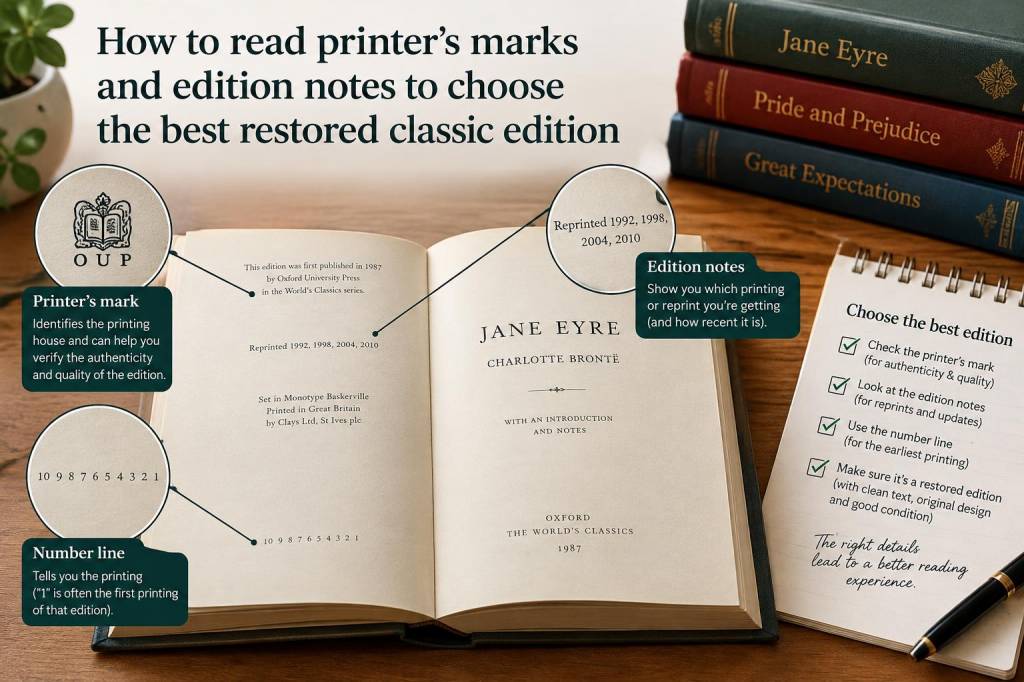
I love handling restored classics—not because they smell of glue and oak (though that’s part of it) but because each edition is a small argument about how a book should be read. The front matter, the little printer’s mark tucked into the colophon, the editor’s notes: these are not just bibliographic niceties. They are the clues that tell you whether an edition is aiming to be faithful to a first printing, practical for reading, or deliberately interpretative. Here’s how I approach those clues when I’m choosing which restored edition to bring home.
Start at the title page and copyright page
This is where most of the useful signals live. Don’t skip it—publishers hide important information here.
Look for the edition statement: “First published…,” “Revised edition,” “Newly restored.” That helps you understand whether the text has been through recent editorial intervention.Find the printer and place of printing. A colophon or line with a printer’s name (e.g. “Printed by Clays Ltd, St Ives”) can indicate the quality of paper and binding—important if you care about production values.Check the publication history. If a modern publisher writes “This edition is based on the 1812 first edition and the author’s corrected proofs,” that’s a strong sign of textual care.Even the ISBN and series name tell you something. Penguin Classics, Oxford World’s Classics, NYRB Classics, Everyman’s Library, the Folio Society and Modern Library all have different editorial priorities. Knowing what those are helps you set expectations.
Read the editor’s introduction and notes carefully
The introduction is where editors justify their choices.
If the introduction explains the editorial principles—how they chose a copy-text, whether they collated multiple editions, whether they modernised spelling—you can judge the edition’s aims.Watch for phrases like “based on the first edition”, “revised from”, “established text” or “text restored from manuscript”. Each means something different: “based on the first edition” may privilege an author’s initial publication; “restored from manuscript” suggests intervention to recover lost or suppressed material.If the editor lists textual variants and provides an apparatus criticus (footnotes or an appendix listing differences between editions), that’s invaluable if you care about the textual history.When I want the most authoritative restored text for a neglected classic, I choose editions where editors show their working—citing manuscripts, early printings, and explaining emendations. If the introduction reads like marketing copy, the edition may be more about readability or branding than textual recovery.
Understand the printer’s marks and colophon
Printer’s marks—those tiny emblems or the colophon paragraph—look decorative but they are practical.
The colophon often states the typeface, the paper grade, and the printer. High-end printers and paper-makers (e.g. Mohawk, G.F. Smith, or paper described as “acid-free” or “archival”) indicate editions built to last.Fine presses and the Folio Society will note the paper’s weight and the binding method. If you’re buying a collector’s copy, that matters for longevity.For scholarly purposes, the more relevant part is the bibliographic colophon that lists the edition history. It may read: “This edition was set from the 1724 third edition with reference to the author’s manuscript held at…” That tells you where the text came from.Decipher textual signals: variant readings, emendations, and conjectures
Not all editors handle textual problems the same way. Here are phrases and what they mean:
“Variant readings” — lists of alternative words or sentences found in other editions. Useful for tracing how a text changed over time.“Emended” — the editor has altered the text where the original seems corrupt. Good editors justify emendations; beware of unexplained changes.“Conjectural emendation” — an educated guess where the text breaks down. Fine for clarity, but note it’s not original.“Based on manuscript” — the edition privileges the author’s manuscript as authoritative; this is often desirable when a printer introduced errors.“Collated with” — the editor compared several copies/editions. Collation is a hallmark of rigorous textual scholarship.When an editor provides a critical appendix listing variants, you can see what’s been changed and decide whether you prefer the restored reading or a different version. I keep editions with good apparatus for reference, and a reader-friendly edition for casual rereads.
Match edition type to your reading aims
Not every reader needs a heavily annotated scholarly text. Ask yourself: do I want fidelity to an authorial intent, or do I want a pleasurable, annotated reading experience?
If you are a scholar, student, or curious reader who enjoys comparing texts: choose editions with full textual apparatus, clear editorial statements and scholarly notes (critical editions from university presses, Oxford or Cambridge scholarly texts).If you want context and accessible notes: look for introductions that explain historical, cultural, and literary background without drowning the page in footnotes (Penguin Classics, NYRB Classics often excel here).If you’re collecting: consider The Folio Society or High-end Everyman’s Library bindings for durability and design. Their colophons usually detail materials and production—helpful if you care about longevity and presentation.A short checklist before you buy
| Check | Why it matters |
| Edition statement / publication history | Shows source texts and editorial lineage |
| Editor’s introduction | Explains editorial principles and methodology |
| Colophon / printer’s mark | Indicates production quality and sometimes paper type |
| Notes & variant apparatus | Tells you how transparently changes were made |
| Series reputation (Penguin, NYRB, Oxford, Folio) | Gives a quick clue about goals: readability vs scholarship vs aesthetics |
Practical buying tips
When in doubt, I compare physical copies in independent bookshops where possible. Seeing the text in hand helps: is the typeface inviting? Are footnotes intrusive? If you can’t inspect the book, read the publisher’s note online—most good editions have detailed back-matter previews on their websites or on Google Books.
For rare or vexed texts, consult bibliographies and scholarly reviews (Journal of the Textual Society, Times Literary Supplement) that evaluate editions.Don’t dismiss newer editions: modern editors often correct long-standing errors thanks to better access to manuscripts and digital collations.If the choice is between an annotated paperback and a beautiful but lightly annotated hardback, consider buying both: one for reading, one for the shelf.Picking a restored classic is like choosing a companion for a long walk through someone else’s imagination. Read the clues, weigh your priorities, and let the edition you choose be one that helps the book speak clearly to you.