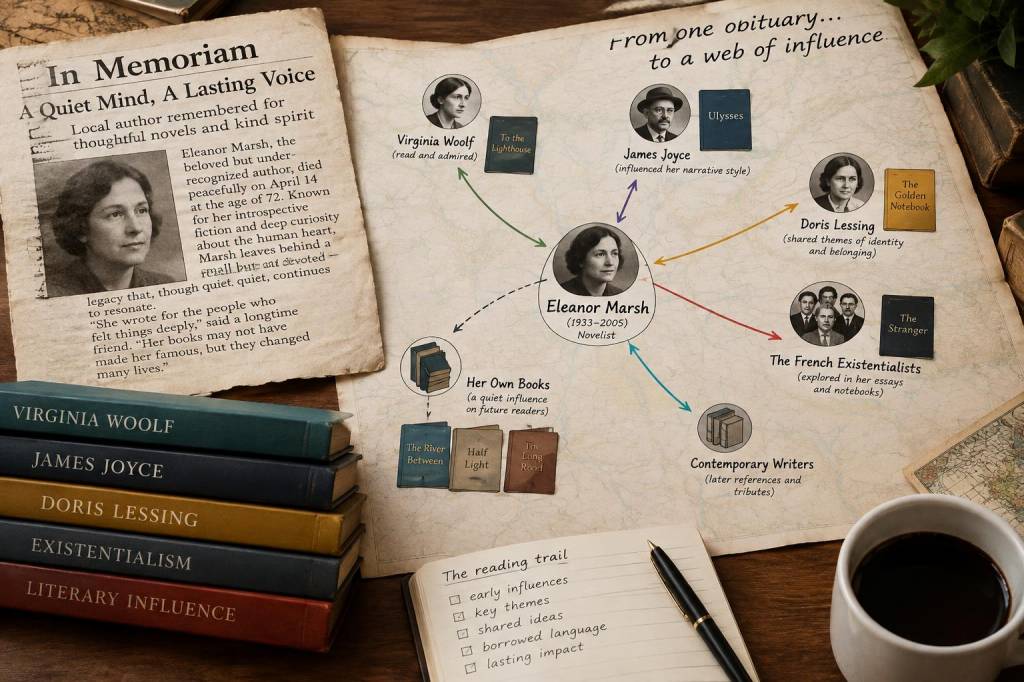
If you’ve ever stumbled across a brief obituary in a local paper and felt the tug of a story that refuses to leave you alone, you’re not alone. I’ve learned to treat those short notices like doorways: small, oddly framed, but opening onto whole rooms of reading, networks and influence. In this piece I’ll walk you through how I turn a single archival obituary into a map of a neglected author’s influences and reading trail. The method is practical and repeatable, and it’s one of my favourite ways to discover writers who have fallen quietly off the map.
Why an obituary?
Obituaries condense a life into a handful of public facts: birth and death dates, a career outline, sometimes a list of works, surviving relatives, clubs and societies, places lived and — if you’re lucky — a note about what the person read, taught or collected. These fragments can act as signposts. A publisher’s name hints at networks; a bequest to a library suggests where papers might be; a mention of “collector of early poetry” suggests a possible personal library to trace. For neglected authors, obituaries are often the only contemporary summary available, and they frequently outlast other ephemeral records.
First pass: read slowly and extract every usable datum
When I open an obituary I read it three times. The first read is for the obvious facts: dates, places, titles. The second is for ephemeral clues: clubs, addresses, nicknames, who wrote the obituary, and whether it mentions donations of books or papers. The third read is for absences — what the obituary doesn’t say that might be telling.
- Underline names — publishers, editors, contemporaries, family members.
- Note institutions — schools, societies, churches, libraries.
- Record locations — streets, houses, towns — even short-lived addresses can be matched to census records.
- Flag mentions of collections — “left his books to…” is gold dust.
Build a quick research checklist
From the obituary I create a one-page checklist. It’s a working map of where to look next. Typical items include:
- Full name variations (middle names, initials).
- Dates and places to search in censuses and directories.
- Newspapers and periodicals that ran the obituary (to find related notices).
- Library names and archive repositories mentioned.
- Publishers and journals cited — search their catalogues and indexes.
Follow the institutional breadcrumbs
If the obituary says the author was “a member of the Athenaeum” or “left his library to the town library,” those are next stops. Institutional archives often hold membership lists, donation records and correspondence. Practical places to check:
- Local and national archives (e.g., county record offices, The National Archives, British Library).
- Library catalogues and Special Collections — use terms from the obituary to search catalogues like COPAC/Discover and WorldCat.
- Society and club minute books (many now digitised or available by request).
When I find a donation record, it can be revelatory: an inventory of the books given, a note about the condition, or the donor’s letter explaining why they donated. That list alone can map taste and influence — editions, translations and the marginalia if present.
Trace the publishing trail
Obituaries often list an author’s works and publishers. Tracking those publishers, and the other authors they published in the same period, is a fast way to map an author’s immediate literary company. Look for:
- Publisher catalogues and series (who else appears in the imprint?).
- Contemporary reviews and advertisements in digitised newspapers (the British Newspaper Archive, Trove, Chronicling America, local digitised titles).
- Literary journals where the author might have published reviews or essays — these often reveal both the books they read and their critical circle.
Follow reviewers, friends and executors
Who wrote the obituary? If it’s penned by a colleague or a more famous contemporary, their other writings and correspondence can contain references to the deceased’s reading. Executors named in the obituary often appear again in probate records and correspondence. I’ve found entire marginal collections mentioned in letters that simply wouldn’t show up in public catalogues.
Use census, directories and probate to find addresses — then local libraries
Once you have an address you can search trade directories, the census, and electoral rolls. This tells you who lived nearby and what kind of neighbourhood the author occupied — which local libraries, reading rooms or societies were within easy reach. Sometimes a writer’s nearest lending library is the single most likely source of the books they read.
Probate records are especially useful because they often list personal effects and executors, and sometimes value the estate. A small bequest to a local library might be recorded there and cross-referenced with library accession logs.
Look for evidence of ownership: marginalia, bookplates and auction records
Finding an entry for the author in auction catalogues (Sotheby’s, Christie’s, or smaller provincial houses) or bookplate registries can reveal the contents of their collection. Marginalia in held books — if you can access them — is the clearest evidence of reading practices. Many libraries now digitise notable annotated books, or allow supervised access to view marginalia. Always ask the Special Collections team for assistance; they’re often delighted when a small obituary leads to renewed interest in a donor’s library.
Map networks with tools you probably already use
You don’t need sophisticated software to map connections. I use:
- Zotero to collect citations and link the people, works and institutions.
- Simple spreadsheets to list names, dates and relationships.
- Gephi for visualising denser networks, if I’m compiling many connections.
Start with a central node — the subject — and add edges for publishers, correspondents, libraries and books. Even a hand-drawn map is useful: placing people, places and books near each other often suggests previously unnoticed avenues to explore.
Use periodicals to read the reading
If an obituary says the author was a reviewer or contributor, hunt for those pieces. Reviews reveal not only taste but also what the author thought important enough to criticise or champion. Many periodicals are now searchable online; for older material, JSTOR, HathiTrust and Google Books are excellent. Read a handful of reviews or essays from the same decade — patterns of quotation and reference will emerge: favourite poets, recurring critics, and other writers who appear repeatedly.
Contact living relatives and local historians
Obituaries name surviving family members. A respectful email to descendants or to local historical societies can pay dividends. People often keep letters, cuttings and photographs that never made it to an official archive. I always explain who I am, what I’ve found, and what I’m seeking; I offer to share my findings and to photograph any materials they’re willing to show me. Such conversations sometimes unearth private libraries or oral memories that reorient the whole project.
Turn fragments into narrative — and leave breadcrumbs
As your map fills out, write short notes connecting evidence: “Donation to X library in 1923 suggests access to Y’s edition,” or “review in 1911 references Z poet — check Z’s correspondence for a reply.” These small hypotheses help keep the search focused. I also keep a list of dead ends — they matter, because they tell you where not to look next and can prevent repeating work.
Finally, share the map. Post an edited inventory of found items to the library that holds the obituary, and consider depositing your notes in a related archive or a digital repository like the Internet Archive or a university repository. You’ll be surprised how often a map you publish helps other researchers pick up the thread where you left off.