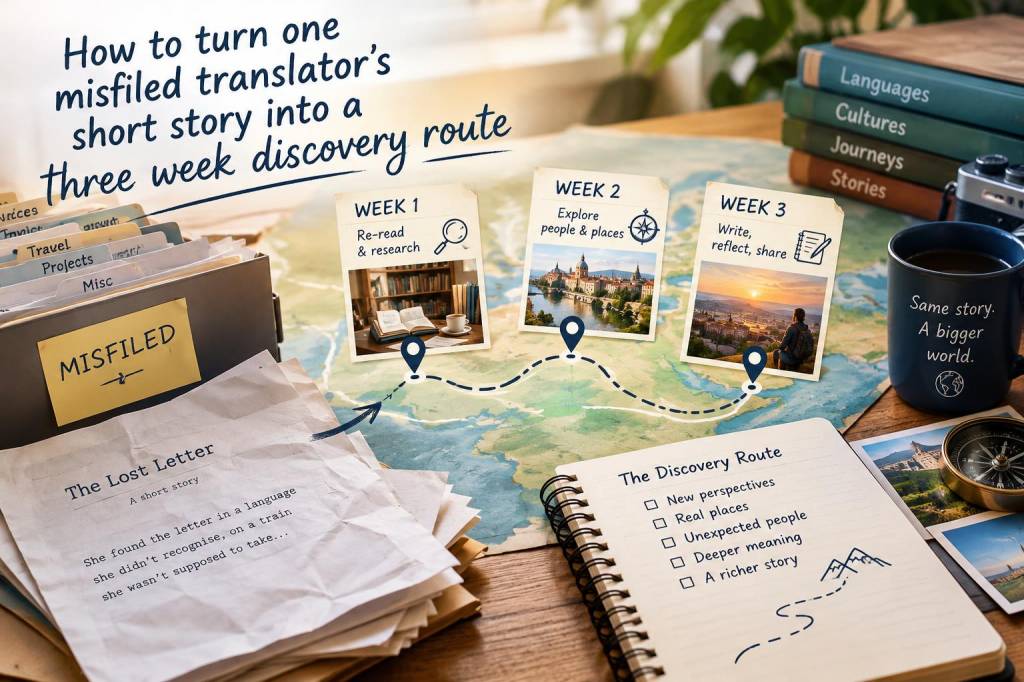
I found the story on a rainy Wednesday, tucked between a volume of 19th‑century essays and a travel diary. It had been misfiled under "Foreign Literature — Misc." The card in the back of the book declared it a short piece by an unknown author, translated by a translator whose name I recognised but whose work I hadn't seen in years. That little discovery — the misfiled story, the familiar translator's name — became the seed for a three‑week reading route that I designed to map not only that story's circuitous life but the cultural conversations it touched. If you like the idea of following a single, overlooked strand and letting it unfurl into a whole itinerary of books, people and places, this is how I usually do it.
Why build a discovery route from one short story?
Short stories are incredible hinge points. They are compact, often experimental, and their brevity makes them agile: a story can travel between languages and markets more quickly than a novel. A misfiled story feels like an invitation — an argument that something worth reading has been overlooked. From that shard, you can reconstruct context: the translator’s choices, the author's other works, contemporaries who reacted to it, and the historical moment it came from. The route becomes both chronology and conversation.
Week 1: Read the story as an object
This first week is about intimacy. I read the story twice: once for pleasure and once as an artifact. Take notes in the margins, or use a small, dedicated notebook. I pay attention to voice, rhythm, recurring images, and anything that feels unresolved.
- First read: Let the story wash over you. Don't stop for research yet.
- Second read: Annotate. Mark unfamiliar references, stylistic quirks, and moments the translator might have moulded.
- Practical tools: I often use a slim Moleskine notebook and a mechanical pencil. If you prefer digital, Evernote or Notion work well for collecting quotes and links.
Questions to answer by the end of week one: Who is telling the story? What is left unsaid? What cultural or temporal markers are present? If the translator has a preface or a note, read it closely — translators frequently reveal a lot about their approach to a text.
Week 2: Trace the translator
Translators are the road maps through which books cross linguistic borders. In my case, the translator had translated half a dozen novels and scattered short pieces. I spent the second week following them.
- Search for other works they translated. Look on WorldCat, publisher pages, and translator associations (for example the Society of Authors in the UK or the American Literary Translators Association).
- Read translators’ notes, interviews, or Twitter threads. Many translators discuss specific choices publicly — why they chose a word, how they dealt with idiom.
- Compare the misfiled story to a longer piece translated by the same person to see stylistic fingerprints. Is there a tendency to domesticate or to preserve foreignness?
During this week I also hunt for reviews and reception history. If the translator has a professional website, it can yield publication dates that help place the short story in a publishing timeline. If they’re active on social media, you can sometimes contact them with a polite question; translators are often delighted when a reader notices a smaller piece of their output.
Week 3: Expand outward and follow the threads
By the third week, the story has given me several departure points: the author's themes, historical context, similar writers, and translations. I create a three‑part itinerary for the week: reading, listening/interviewing, and wandering.
- Reading: Pair the misfiled story with two or three related texts. These might be other short stories by the same author, a contemporary writer dealing with the same themes, or a critical essay. For instance, if the story touches on migration, I look for essays on immigrant literature in that country and a novel that treats the theme at length.
- Listening/Interviews: Seek audio: podcasts, recorded interviews, or radio pieces about the author, translator, or era. The BBC, local cultural radio stations, and university lecture series are great sources. If possible, reach out to a scholar or a small‑press editor for a 20‑minute conversation — many are willing to speak with readers exploring a niche piece.
- Wandering: This is my favourite and most idiosyncratic part. Walk a neighbourhood connected to the author's life (virtually, if you can’t travel), explore maps, or visit local bookshops. Independent bookshops like Daunt or local university libraries often hold odd translations or provide access to journals that mainstream outlets do not.
Tip: I create a simple table of the week’s materials — a short story, a companion book, an essay, and a podcast episode. Presenting it visually helps keep the route manageable and pleasurable.
| Item | Purpose |
| Misfiled short story | Primary text — baseline experience |
| Another translated piece by the same translator | Compare translation choices |
| Critical essay or review | Contextualise themes and reception |
| Podcast/interview | Hear voices and tones not present on the page |
Questions people usually ask
Here are some practical queries I get asked when I suggest this method.
- How do you find materials if the author is obscure? University library catalogues, JSTOR, and Google Scholar can unearth dissertations and reviews. WorldCat will show which libraries hold which translations. Local specialist bookshops and small presses are invaluable.
- What if there’s no information on the translator? Follow the translator's publication trail. Even a single other translated text can reveal an aesthetic. If all else fails, treat the translator as an anonymised voice and focus on the story’s original cultural markers.
- How do you balance depth and delight? Set time limits. My three‑week route is deliberately modular: each week has a clear, manageable aim. The idea is curiosity sustained, not exhaustive scholarship.
Sharing and documenting your route
Part of the pleasure is sharing discoveries. I keep a public reading list on Storyscoutes Co and on Goodreads, and I sometimes publish a short “route map” that includes reading checkpoints, quotes, and links to recordings. If you keep a log — on a blog, Notion, or even Instagram — you create a resource others can follow and add to.
Finally, don't be afraid to let the route bend. A misfiled story doesn't always lead to tidy answers; more often, it points to more misfilings, marginalia, and delightful detours. That’s the point. The route is less a straight path than a series of small explorations, each inviting you to look again.