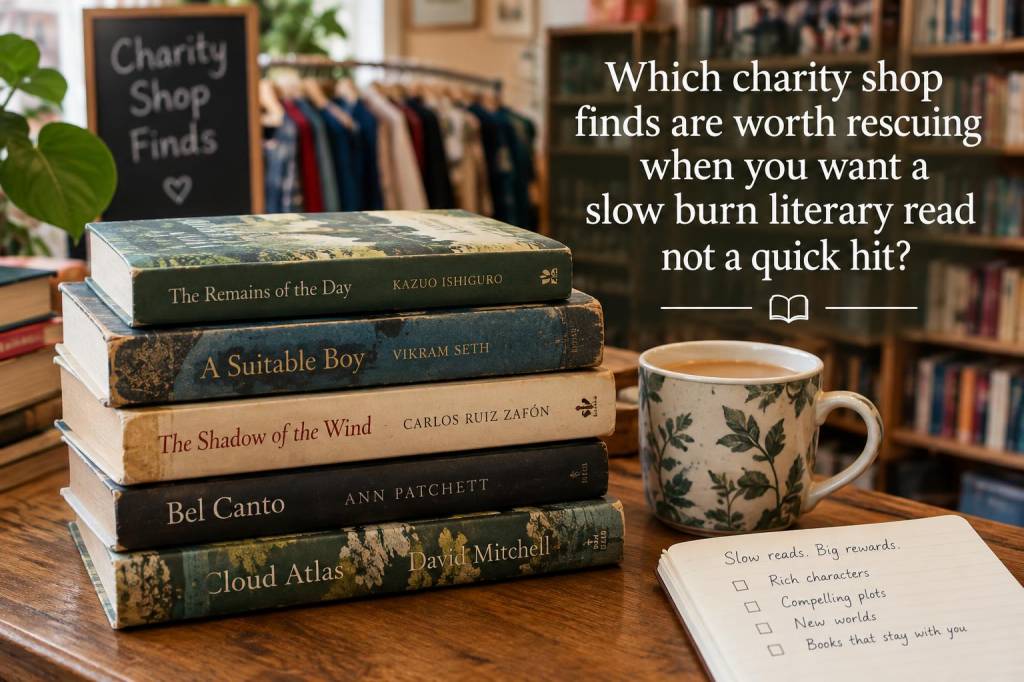
I have a soft spot for the books that do not announce themselves loudly. In a charity shop, they are often the spines that sit a little crookedly on the shelf, the jacket that looks faded but still dignified, or the thick paperback whose cover design belongs to another decade and seems to carry its own weather. When I am in the mood for a slow-burn literary read, I do not want a book that rushes me into plot twists or chapter-end shocks. I want something that opens gradually, asks for patience, and rewards attention with atmosphere, texture, and a lingering afterglow.
That is why charity shops matter so much to me as a reader. They are not just places to find cheap books. They are places where forgotten literary lives keep circulating. A copy may have passed through several hands, picked up for a holiday, an evening course, a train journey, or a moment of hopeful ambition, and then been returned to the shelf when life got in the way. For a reader like me, that history adds charm. I like the idea that a book has already been tried, abandoned, rescued, and offered one more chance.
What makes a charity shop book worth taking home
When I am searching for a slow-burn literary read, I look past fame and focus on qualities that suggest depth. I want a book that can hold silence, tension, memory, or social detail without constantly pushing for spectacle. Some of my most satisfying finds have been novels that were not especially fashionable when they were published and have since slipped into the half-light.
In practice, I look for a few signals:
- A premise that sounds ordinary but promises emotional complexity.
- A writer with a strong critical reputation, even if name recognition is modest.
- Publication dates from earlier decades, especially when the jacket copy sounds restrained rather than sales-driven.
- Books with a sense of place, family tension, moral ambiguity, or interior reflection.
- Novels that are likely to reward close reading more than rapid consumption.
I also pay attention to the physical object. If a book feels like it has already survived a long life, I take that as a good sign. A slightly worn dust jacket, pencilled notes on the flyleaf, or a price sticker from a now-defunct bookshop can make the experience feel richer. I am less interested in pristine collectability than in the possibility of encounter.
Older literary fiction often hides in plain sight
Some of my most reliable charity shop rescues are mid-century and late twentieth-century novels that were once widely read but no longer dominate conversation. These books often have more patience than current commercial fiction, more room for silence, and more confidence in language. They are especially worth rescuing when they come from writers who were never fully absorbed into the canon but clearly deserve attention.
I am often drawn to novels by writers such as Penelope Fitzgerald, Elizabeth Taylor, Rosamond Lehmann, Anita Brookner, Barbara Pym, and Penelope Mortimer. Their books do not usually shout. They observe. They notice the social awkwardness in a drawing room, the unspoken resentment in a marriage, the tiny fractures in a family conversation. If I want a literary read that unfolds gradually, this is exactly the kind of company I want.
There is also real pleasure in rediscovering writers from outside the most familiar Anglophone centre. Charity shops can be surprisingly good hunting grounds for translated fiction, especially from publishers with strong back catalogues. A slow-burn literary read can come from anywhere: a Russian novella with compressed emotional force, a Scandinavian family story with glacial tension, or a European novel that treats memory as a landscape rather than a plot device.
Paperback series, old imprints, and quiet publishers
One of my favourite things to rescue is a paperback from a serious backlist imprint. Vintage, Penguin Classics, Virago Modern Classics, Picador, Faber, and similar publishers often kept books alive long after their first publication. A charity shop shelf lined with these spines is a promise of depth. Even when I have not heard of the author, I often trust the imprint enough to take a chance.
These editions often lead me to books that are slower, denser, or more formally interesting than contemporary mass-market fiction. They may not offer immediate gratification, but they frequently give me richer weather to walk through. I think of them as books with low commercial volume and high emotional resonance.
Sometimes I choose a book simply because it looks as though someone once cared about it. A clean, well-kept paperback with a thoughtful cover can suggest that it was bought by a serious reader who intended to read carefully. That does not guarantee quality, of course, but it does mean the book has already lived inside an attentive imagination.
What I rescue when I want a slow burn rather than a quick hit
When I browse charity shops, I tend to rescue books that promise atmosphere, ambiguity, or interior movement rather than rapid action. I am happy to leave behind anything that feels engineered for pace alone. My best finds usually belong to one of these categories:
| Family novels | These often unfold through memory, inheritance, and long-held tensions rather than dramatic event. |
| Domestic fiction | I look for novels that treat ordinary life with seriousness and emotional precision. |
| Literary campus or boarding-school fiction | These can be deceptively quiet while exploring ambition, loneliness, and social pressure. |
| Translated literary fiction | Often slower in rhythm, richer in atmosphere, and more open to ambiguity. |
| Classic short-story collections | Perfect when I want cumulative depth rather than one sweeping narrative drive. |
| Essayistic novels | These books let thought and feeling move together at a measured pace. |
I also rescue books that sound slight but are quietly devastating. A novel about a summer visit, a relationship misread, a small provincial town, or a long conversation between relatives can deliver far more emotional force than a high-concept premise. The key is whether the prose has tension in it, even when nothing obvious is happening.
Signs a book may reward patience
Some books are obviously meant to be savoured, and charity shop browsing gives me only a minute or two to judge them. I have learned to trust a few signs. If the opening pages are full of observation rather than action, that is often a good omen. If the narrator notices weather, posture, furniture, social habits, or half-spoken disappointment, I am usually interested. If the prose is willing to linger in uncertainty, even better.
I am also drawn to books that seem slightly unfashionable in their own way. A novel with a restrained style, a morally ambiguous heroine, or a plot that refuses easy resolution often proves more rewarding over time than a louder, cleaner, more obviously marketable work. A slow-burn literary read should leave room for rereading, reconsideration, and afterthought.
When I am unsure, I open the book at random and read a paragraph. If I feel an immediate tonal pull, I buy it. Not excitement exactly, but curiosity with gravity. That is usually enough.
What I avoid, even when it is cheap
Charity shops are full of books I leave behind without regret. If a novel is all premise and no texture, I pass. If the cover copy leans too heavily on twists, secrets, and emotional escalation, I usually know it will not satisfy me. I also hesitate with books that seem designed for instant emotional reward but offer little sense of language or atmosphere.
I avoid:
- Overly frenetic thrillers when I want reflection rather than velocity.
- Books with jacket copy that promises nonstop suspense.
- Works that feel dated in a careless rather than revealing way.
- Celebrity memoirs unless I already have a reason to trust the voice.
- Heavily branded mass-market fiction that feels assembled rather than written.
That said, I do not dismiss a book simply because it is popular. Some widely loved novels are slow, rich, and beautifully made. My filter is not prestige but rhythm. I want a book that will keep unfolding after I have put it down, a book that invites attention without demanding haste.
Why charity shop hunting suits this kind of reading
There is something beautifully democratic about finding a literary gem among donated books. A new hardback often arrives with a clear identity: reviews, publicity, a sales campaign, a declared place in the market. A charity shop book arrives with less certainty. It may have no recent conversation around it, no algorithmic boost, no social-media momentum. That makes the act of rescue feel personal.
I enjoy the slowness of the search as much as the reading itself. Browsing charity shop shelves trains my eye to notice subtler things: a respected author whose work I have missed, a novel from a period I want to revisit, a translation I have not heard discussed, a slim book whose quietness seems to promise depth. It is a very different pleasure from clicking “buy now.” It involves hesitation, hunch, and trust.
And because I often do not know exactly what I am bringing home, the book retains its potential mystery. Some will be merely pleasant. Some will be good in a conventional way. Once in a while, though, a rescue becomes unforgettable: a book that changes the mood of a week, that settles into memory, that proves more human than expected. Those are the finds I keep coming back for, the ones that remind me why I still prefer chance encounters to predictable recommendations.
I never mind when a charity shop book has been underlined, softly bent, or read in a difficult moment. Those traces do not diminish it for me. They make it feel used in the best sense: touched by another reader, released back into circulation, ready to begin again with someone else. For a slow-burn literary read, that kind of past can feel like part of the text itself.