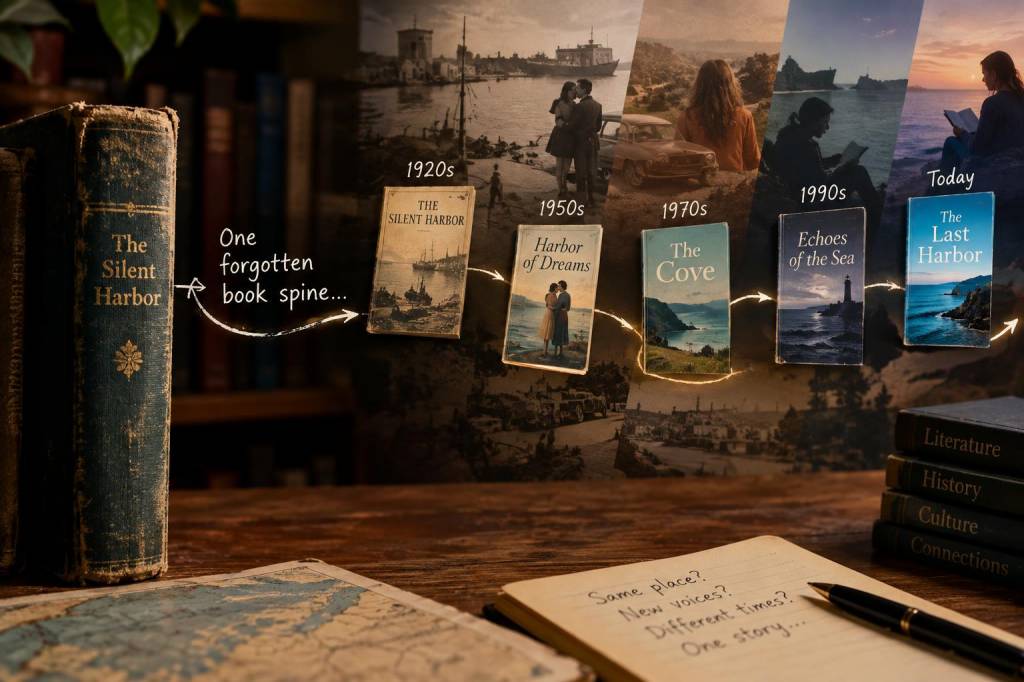
I often begin a reading route with something almost embarrassingly small: a spine that has faded on a library shelf, a name I half-recognise, a cover design that feels out of step with its neighbours. A forgotten book can behave like a sealed room with one loose board. Once I notice it, I want to know what is hiding around it: who was writing in response to it, who borrowed from it, who argued with it, who quietly kept its spirit alive long after its first appearance.
That is how I build a themed route from a single neglected book. I do not start with a grand plan. I start with a spark. A title catches me, I read a page or two, and then I follow the echoes. A route like this is part detective work, part curiosity, part permission to wander. It is less about proving a thesis than about making a small act of attention expand across decades, countries, genres, and moods.
Begin with one book that still feels alive
The first task is choosing a seed text. I look for books that feel under-loved rather than merely old. There is a difference. Some books are widely known but rarely read with care; others have slipped almost entirely from view, which makes them ideal for this kind of exploration. I want a book with a pulse: a novel, memoir, essay collection, poem sequence, or even a travel narrative that seems to be speaking from a particular moment while also reaching toward later ones.
I pay attention to texture. Is there an unusual setting? A distinctive voice? A social tension that feels unresolved? A formal experiment that may have been imitated later? Any of these can become a thread. I once began with a brittle, out-of-print novel whose heroine seemed trapped between private longing and public duty. From that single book, I found a route through domestic fiction, feminist recovery projects, wartime writing, and modern novels still wrestling with similar constraints.
When I choose a seed text, I ask myself three questions:
- What is this book doing that feels unusual, risky, or quietly ahead of its time?
- What subjects, settings, or formal choices recur often enough to build around?
- What later writers might have been in conversation with it, directly or indirectly?
Read for recurring signals, not only for plot
A themed route does not have to follow plot alone. In fact, plot is often the least interesting place to begin. I read for signals: weather, interiors, work, travel, illness, money, inheritance, class, silence, friendship, devotion, exile, ambition. A forgotten book often contains one or two of these motifs in a form that later books will refine, complicate, or reverse.
I underline phrases that feel like invitations. A repeated image of birds in migration might open a route through displacement and belonging. A fixation on city rooms, boarding houses, and rented spaces might lead me toward books about precarity and female independence. A novel set in a provincial town may connect to later writers who turned enclosed communities into laboratories for power, gossip, and desire.
At this stage I keep my net wide. I do not need a perfect line of influence. I only need enough friction between books to make the route interesting. Echoes can be formal, thematic, emotional, or historical. A later novel may not mention the earlier one at all, yet still feel like a descendant by temperament.
Follow footnotes, bibliographies, and old reviews
One of my favourite ways to extend a route is to go backwards through research traces. Footnotes are often tiny maps. A bibliography can reveal a writer’s private reading life. Old reviews can show what an earlier generation noticed, misunderstood, or dismissed. When I want to understand why a book disappeared, I look at its reception as closely as I look at its pages.
There is something thrilling about reading a contemporary review that is wrong for all the right reasons. A reviewer may have thought a book too quiet, too strange, too political, too domestic, too feminine, too regional. Those complaints are often clues. They show me what made the book difficult to place, and that difficulty is frequently what makes it worth recovering.
I also like to search for patterns in later criticism. Did a book vanish and then reappear in a different context? Was it rescued by a scholar, a small press, a reading group, or a new translation? Did it travel differently across borders? These questions help me decide whether the route should move by influence, revival, reception, or resonance.
Build the route across decades, not in a straight line
I do not arrange my reading routes as tidy timelines. I prefer zigzags. A route becomes more alive when I let it move between decades in a way that feels musical rather than mechanical. I may go from a 1930s novel to a 1970s memoir to a contemporary novella, then back again to a mid-century short story collection. This approach lets me hear what persists and what changes.
To make the route readable for others, I usually shape it around a few clear movements. For example, I might trace one forgotten book into:
- an earlier text that prepares its terrain;
- a near contemporary that shares its anxieties;
- a later work that inherits its questions;
- a present-day book that reframes the whole conversation.
That structure creates momentum without flattening the differences between books. I want readers to feel the passage of time, not just the repetition of ideas. Echoes are most revealing when they are not exact.
Let context do part of the storytelling
A themed route becomes richer when I place books inside their worlds. Publishing history matters. So does war, migration, censorship, class politics, regional identity, and the changing place of women, queer writers, colonial subjects, or working-class voices in literary culture. A forgotten book rarely vanished by accident. Often it was pushed aside by institutions, market habits, or critical fashions that favoured other kinds of stories.
I like to ask what else was happening when a book appeared. What was being published in newspapers? What social debates were shaping readers’ expectations? Was the writer in a famous circle or working in isolation? Did the book arrive too early, too late, or in the wrong form? That context does not replace close reading; it sharpens it.
Sometimes I discover that a route is also a history of access. A book written by a woman in the early twentieth century may connect to later feminist recoveries. A Caribbean, South Asian, African, or diasporic writer may lead me into questions about translation, circulation, and critical neglect. In those cases, the route becomes a record of literary visibility as much as literary influence.
Use a simple framework to compare books
When I am deciding whether books belong on the same route, I compare them through a small set of categories. It helps me avoid a vague sense of “they feel similar” and gives me something concrete to write around.
| Dimension | What I look for | Why it matters |
|---|---|---|
| Voice | Tone, rhythm, distance, intimacy | Voice often reveals kinship faster than plot |
| Setting | Urban, rural, domestic, expatriate, institutional spaces | Shared settings can expose shared pressures |
| Concern | Desire, work, memory, inheritance, freedom, power | Recurring concerns make a route feel coherent |
| Form | Fragment, diary, realism, allegory, experiment | Form can carry influence across generations |
| Afterlife | Reprints, adaptations, critical revival, translation | Afterlife shows what survived and why |
This kind of table is not meant to reduce books to boxes. It is a way of making intuition visible. I still trust instinct, but I like to test it against evidence.
Choose companions that widen, not repeat, your first book
I am wary of building a route from books that are too obviously alike. If every stop feels identical, the reading experience collapses into illustration. I want companions that widen the original book’s field of view. If the seed text is intimate and domestic, I may pair it with a political novel that shows similar emotional structures under public pressure. If it is experimental, I may bring in a more accessible book that translates part of its energy into another register.
That is where the joy of discovery really lives. A route can move from a neglected classic to a contemporary debut and make both books feel newly legible. The older text gains freshness; the newer one gains depth. I love when a reader sees a line of continuity that was never obvious before.
I also like to include one slightly unexpected companion, something that interrupts the pattern. A poem, a travelogue, a letter collection, a forgotten essay, a children’s book. These additions can reveal the edges of the original text far better than another novel with the same surface features.
Write as if you are handing over a map, not delivering a verdict
When I turn the route into an article or reading list, I try to write with a sense of invitation. I do not want to sound like I am closing interpretation down. I want readers to feel that they can take the route and bend it, extend it, or start again from another book on the edge of it.
That is why I include small signals of process. I mention what first caught my eye, where a connection emerged, and why a particular pairing matters to me. I find that readers trust a route more when they can see my reasoning. They do not need every connection to be final. They need to feel that I have paid attention.
I also make room for uncertainty. Sometimes a route is built from influence; sometimes it is built from contrast. Sometimes a later book answers the first, and sometimes it simply echoes its mood from a distance. I think of these distinctions as part of the pleasure rather than a problem to solve.
And when I revisit a route after a few months, I often find a new branch waiting: another review, a fresh translation, a reissue from a small press, or a reader’s recommendation that shifts the path in a surprising direction.