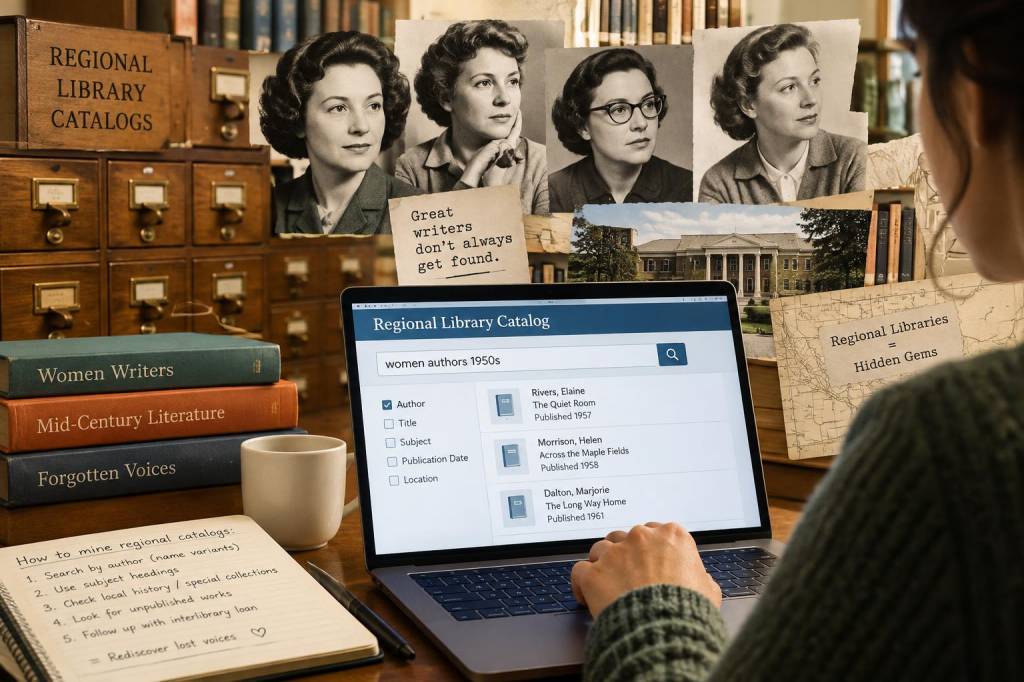
I keep returning to regional library catalogues when I'm hunting for mid‑century women writers who have fallen out of print. There’s something quietly thrilling about a catalog entry that points to a small press run, a local imprint, or a single copy held in a county library—those clues are often the beginning of a scavenger hunt that leads to a neglected novel, an unfamiliar short story collection, or an archival trove of letters. Below I share the catalogues and resources I lean on, and the practical methods I use to mine them effectively.
Which catalogues are most useful?
Not all library catalogues are created equal for this kind of research. Some aggregate widely and surface copies across many institutions; others are local, idiosyncratic and full of surprises. The ones I return to most often are:
- Jisc Library Hub Discover formerly COPAC): aggregates holdings of major UK and Irish academic, national and specialist libraries. Excellent for tracing UK university holdings and small press runs.
- WorldCat (OCLC): global, indispensable for locating single copies in public, academic and special collections worldwide.
- Trove (National Library of Australia): superb for Australian writers and for digitised newspapers, magazines and ephemera that mention writers or small publishers.
- Digital Public Library of America (DPLA) and Europeana: great for digitised items—reviews, serial publications, scans of dust jackets and author portraits.
- National library catalogues: British Library, National Library of Scotland, National Library of Wales, Library and Archives Canada—their local holdings and special collections often include small press material and letters.
- Local authority and county library catalogues: think Leeds Central Library, Manchester Libraries, Cornwall Libraries—these can hold local-author runs, author archives and out-of-print pamphlets.
- Specialist and institutional catalogues: The Women’s Library at LSE, Bodleian Library’s SOLO, Wellcome Library (for medically inflected texts), and university departmental libraries.
- Newspaper and periodical archives: British Newspaper Archive, Gale Primary Sources, local paper archives indexed through regional libraries—useful for reviews, interviews and notices that don’t make book databases.
How I structure searches to find mid‑century women writers
My searches are rarely single-line queries. I combine approaches so I don’t miss a title because of catalogue quirks or inconsistent metadata.
- Start broad, then narrow: begin with the author’s name (including known variants) and then add date ranges (1940–1970, for mid‑century). If a name is common, add “novel”, “fiction” or a likely subject term.
- Try publisher and imprint searches: many women writers were published by regional or short‑lived presses. Search by publisher names you know (e.g. Virago’s early lists, small local presses) or by town names in the imprint.
- Use subject headings: Library of Congress Subject Headings (LCSH) and local subject headings can reveal grouped materials—try “Women authors,” “Women—Fiction,” “English fiction—20th century” and more specific topical headings.
- Wildcard and truncation: use * (if the catalogue allows) to catch variant spellings: “Kath*” to find Katherine/Kathleen etc. Use Boolean operators (AND, OR, NOT) to combine things like “Anne AND novel AND 1950-1960.”
- Search within formats: don’t forget periodicals, pamphlets, broadsides and correspondence—these formats often preserve work that never made it into a commercial paperback.
Mining local and special collections effectively
Once a catalogue points to a promising holding, there are several practical steps that tend to pay off.
- Read the catalog record carefully: notes about provenance, former owners, or “inscription” can signal a manuscript or private press copy. “Reference only” doesn’t mean poor quality—it often means a unique or fragile item.
- Follow the breadcrumbs: a single review in an old regional newspaper can identify a local reading group, an obscure reviewer, or a rival author whose name leads you to more titles. Create a list of names and search them across Trove, British Newspaper Archive, and DPLA.
- Contact the librarian: many regional and specialist libraries have staff who love a good mystery. An email describing what you’re looking for often yields suggestions not visible in the online catalogue—uncatalogued boxes, index lists, or upcoming digitisation projects.
- Request scans or visits: where possible I ask for a digitised page or two to confirm an author’s name or a dust jacket photo. If an item is unique, plan a visit; there’s nothing like holding a first edition or a typescript to change your perspective on an author.
- Use interlibrary loan and private sellers: WorldCat and Jisc will show where copies exist—if they’re not available locally, an interlibrary loan or a secondhand seller (ABE Books, Alibris, local antiquarian booksellers) can help you access them.
Seeking the overlooked — what to look for beyond the obvious
When I’m chasing mid‑century women writers who’ve been overlooked, I attend to a few recurring patterns:
- Small press runs and university presses: short print runs mean fewer copies survive. University and regional presses sometimes published experimental or local-interest books that mainstream publishers ignored.
- Ephemeral publications: short stories and serialised novels in magazines—seek out literary journals, women’s magazines and local periodicals.
- Alternative names and pseudonyms: women sometimes published under initials, pseudonyms or married/maiden names. Cross‑checking birth names, married names and pen names is crucial.
- Local themes: novels rooted in a county, coastal town, or factory community may have been published locally and never reissued nationally. Search by place names and subject headings focused on regions.
- Translation and diaspora publishing: mid‑century women writers from minority communities might be catalogued by language or country of origin; broaden searches to include translated titles and foreign imprints.
Example search path — a practical case
Imagine you’ve seen a passing reference to a “novel set in a 1950s seaside town by a woman writer from Cornwall.” I would:
- Search Jisc Library Hub Discover and WorldCat for keywords: “Cornwall fiction 1950s novel woman” and for place‑names within the title or summary.
- Search Cornwall Libraries catalogue and local newspapers via the British Newspaper Archive for the author’s surname or the novel’s title fragment.
- Look up small Cornish presses in the period and search by publisher name—there may be a local imprint noted in a catalogue entry.
- Contact the county archive or local studies librarian with the reference; ask about house journals, local reviews and private press collections.
- If I find a single copy in a regional library, I request a scan of the title page and ISBN/printing details, then check WorldCat for other holdings or secondhand copies.
Tools and tricks I can’t live without
- RSS alerts and saved searches: many catalogues let you save searches or set alerts—handy for when a new catalogue entry or digitised item appears.
- Bibliographic databases: JSTOR, MLA International Bibliography and EBSCO can reveal scholarly mentions that point to primary texts.
- Publisher histories and sites: Persephone Books, Virago Modern Classics and small independent reprint projects often rescue mid‑century women—check their bibliographies and backlists.
- Community knowledge: bookish Twitter/X threads, small press mailing lists and local history Facebook groups frequently surface leads and scans shared by collectors.
Mining regional catalogues is slow work, but it’s wonderfully addictive. The payoff—finding a luminous, unread novel in a county library whose record has sat largely untouched for decades—is one of the quietest and most satisfying joys of literary discovery. If you have a stubborn lead you’d like me to look at, tell me where you’ve searched and what you’ve found so far—I’m always happy to swap treasure maps and search strategies.