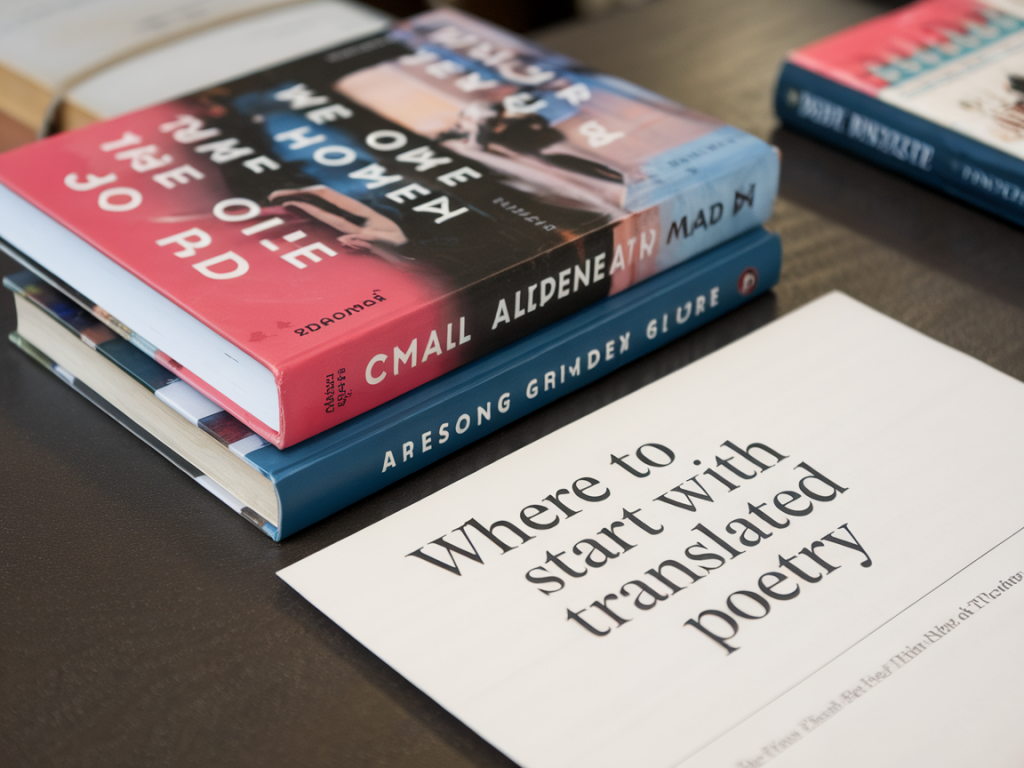
I often find that the first barrier to reading translated poetry is not the language itself but a hesitation: will I be reading the poet, the translator, or both? Over the years I’ve learned that the best way into translated poetry is to lean into that uncertainty. A skilful translator is not an invisible machine but a companion — someone who listens, argues, and answers back to a poem in another tongue. Below I offer three translators I return to again and again, the editions I’d suggest you start with, and the things I pay attention to when a poem has been carried across language.
Anne Carson — for lyric intimacy and dazzling strangeness
Anne Carson occupies a curious space: she’s a poet who translates, and her translations feel like original poems that also happen to be translations. If you’ve never read her work, start with her edition of Sappho (e.g., If Not, Winter). Carson works with fragmentary texts, and her decisions — to leave gaps, to choose a spare modern diction, to add brief prose notes — make the experience of reading an ancient poet both immediate and uncanny.
Why read Carson first?
How to read Carson: read slowly and aloud. Treat the fragments as questions rather than puzzles to complete. Notice where she preserves lacunae and where she invents connective tissue; that silence is often the point.
Robert Fagles — for narrative sweep and the music of performance
If you’re interested in poetry as performance — lines that want to be spoken, epics that ride on rhythm and rhetorical energy — Robert Fagles is a dependable place to start. His translations of Homer’s Odyssey and Iliad, and his rendering of Sophocles, helped to redefine how contemporary Anglophone readers approach ancient verse. Fagles’s diction is warm and muscular; he attends to the narrative pace while shaping idiomatically English lines.
Why read Fagles?
How to read Fagles: if possible, listen to a recording of the translation as you read (many public libraries and audiobook platforms have readings). Pay attention to his choices for set-piece speeches and catalogue passages — where English needs a breath, he gives one.
W. S. Merwin — for a meditative, elegiac sensitivity
W. S. Merwin was an American poet whose translations — especially from Spanish (and earlier in his career, from French and other sources) — are infused with his own lyrical sensibility: sparse, often unpunctuated lines that emphasize fluid image and associative logic. His translations of modern Spanish-language poets (and his versions of ancient texts later in his career) have a quiet insistence: they aim less to reproduce a recognizable voice than to recreate a tonal field.
Why read Merwin?
How to read Merwin: give yourself silence around the poems. Let the unpunctuated lines open and close in your breath. Compare a passage (if you can) with another translator’s version to see how different formal choices shape meaning.
How to choose which translation to read
There are too many approaches to translation to pretend there’s a single correct one. But when you’re starting out, a few practical rules help:
A little chart to help you decide quickly
| Translator | Best for | Suggested starting text | Reading tip |
|---|---|---|---|
| Anne Carson | Lyric fragments, intimate ancient voices | If Not, Winter: Fragments of Sappho | Read aloud; honour gaps and silences |
| Robert Fagles | Narrative epics, performative verse | The Odyssey or The Iliad | Listen to recordings to catch cadence |
| W. S. Merwin | Minimalist, elegiac modern voices | Selections of Spanish-language poetry (check individual editions) | Allow space; compare with denser translations |
Practical reading strategies I use and recommend
When I approach translated poetry I try to do three small things every time:
If you’re learning a language, pair the translation with the original if you can. Even a non-fluent reader gains from seeing how line breaks, cognates and word order change the music of a poem. Online resources like the Poetry Foundation, Modern Poetry in Translation and publisher pages often provide bilingual texts or helpful commentary.
Some invitations, not edicts
Finally: treat these recommendations as invitations. Translation is a conversation that keeps growing. You might fall for the muscular storytelling of Fagles, then be unsettled and delighted by Carson’s fragmentary modernism, or you might find Merwin’s quiet tones are what you crave after a long day. Whichever you start with, allow yourself to follow what surprises you — sometimes that is the best compass for discovery.