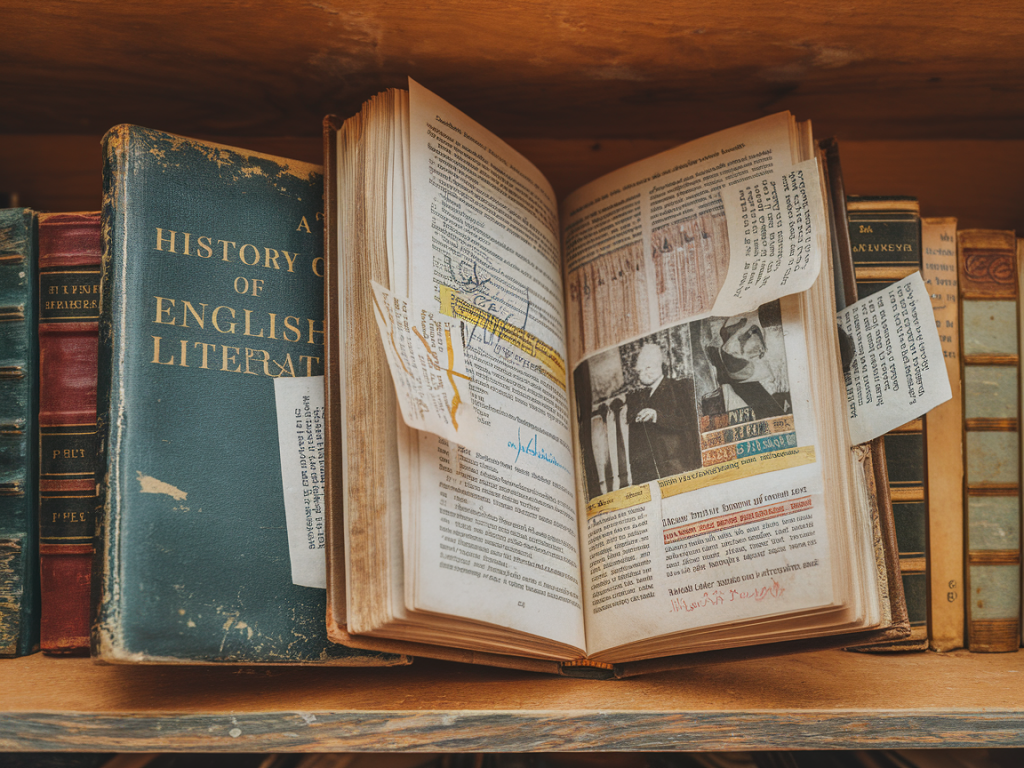
I bought the book for a pound from a charity shop on a wet Tuesday afternoon. It was shelved among other paperbacks that had outlived their first readers—spines softened, dust jackets creased—until a laminated sticker from Oxfam suggested they might live a second life. I took it home mostly because of the scrawled notes on the flyleaf: a blue biro handwriting that spilled across the margin like an old friend's whisper. The book was otherwise unremarkable: a mid‑century novel by an author who no longer draws festival queues. What made it compelling was not the story between the covers but the visible, tactile history of reading that the previous owner had left behind.
The object as archive
Marginalia turns a printed book into a palimpsest. The annotations, underlinings and slips of paper pressed into pages are a reader's low, persistent conversation with a text. Finding a marginalia‑rich book in a charity shop is like stumbling across a miniature archive—private, messy, and startlingly public. These marks can tell you about the reader's attention, their confusions, their moments of delight, and their intellectual rhythms.
In this particular copy, the notes struck me for their regularity. Every chapter had short comments—single words like “True” or “Why?”, a few longer reflections, an underlined sentence here and there. Dates were pencilled in the margins: March–April 1976. There were grocery lists tucked between pages sixteen and seventeen, a bus ticket from 1978, and once, a dried-out tea leaf that had made a brown ring on the paper. The book had been handled, carried, thought with, and lived with.
What marginalia can reveal about a vanished habit
We often assume today's reading habits—e‑books, audiobook subscriptions, social feeds—are merely evolutionary steps from the past. But the physical evidence of how reading used to be done can be strikingly different. That charity shop book suggested a reading habit that is less linear, more communal, and more materially entangled than the solitary, screen‑based reading many of us now default to.
Here are a few impressions I drew from the annotations and ephemera:
These features point to a reading habit marked by slow accumulation, embodied practices, and small economies of attention—habits that are becoming rarer in an age of instant digital reading.
How to trace the reading habit in other books (a practical guide)
If you want to follow this trail, marginalia is an accessible starting point. Here are practical steps I use when I want to treat a second‑hand book as a historical object rather than just bargain literature.
| Step | What to look for | What it might tell you |
|---|---|---|
| Examine handwriting | Ink — pen type, pencil; pressure; changes in hand | Multiple readers, age of annotations, impulse vs. considered notes |
| Check dates and ephemera | Marginal dates, tickets, receipts, postcards | When and where the book was read, travel habits, socioeconomic indicators |
| Map emphasis | Frequency of underlining, repeated themes, page clusters | Which parts resonated, provoked or confused the reader |
| Look for language | Personal pronouns, exclamations, shorthand notes | Tone of engagement—critical, admiring, skeptical |
Use a notebook or a phone to record observations. Photograph pages for closer study (be mindful of any copyright or seller rules), and compare multiple copies of the same title if you can. Librarians, particularly those at local history or special collections, can be unexpectedly helpful if you hit a larger pattern or want to explore provenance.
Reading networks and the sociology of second‑hand books
Marginalia rarely exists in isolation. The book I bought carried marks that suggested it had circulated: a sticker from a university book sale, pencilled initials on the flyleaf, an ex‑libris stamp faintly visible beneath a price label. These are breadcrumbs of a social life. Tracing them can reveal more than one reader’s interiority; it can map a community's reading practices.
For example, charity shops and local book fairs in the 1960s–1980s were hubs for informal literary exchange. Book groups met in church halls and pubs; staff recommended titles behind counters; university students passed-on paperback editions across dorms. Physical circulation created shared textual knowledge—a kind of oral history rendered on paper.
To reconstruct a reading network, I follow leads outward from the book:
Why this matters now
We talk a lot about what we’re losing—tactile pleasures, depth of attention—but I find it more useful to see marginalia as a record of different literacies rather than a lost art. The practice of annotating, sharing and carrying books produced a mode of reading that was distributed across bodies, social spaces and material constraints. It encouraged slow noticing, argument, and repair.
When I trace those marks I’m not only learning about a single reader; I’m connecting to a culture of reading in which books were social instruments as much as personal possessions. Recovering traces of that habit helps us think about what we might want to preserve, adapt, or deliberately reinvent in our own reading lives—whether that means keeping a reading journal, lending books with notes attached, or simply resisting the urge to treat every page as infinite and disposable.
After I finished my first round of notes on that charity shop copy, I slipped it back onto my shelf. The marginalia had multiplied my curiosity: about the reader who had written “Remember Aunt M.” in the margin, about the damp stain that suggested the book had been read in a small kitchen, about the quiet economies that sent that volume from hand to hand. The book remains a quiet companion—its margins a small public record of what reading used to be like, and a prompt for thinking about how we read today.